Quick answer
Entry to the port area at A-Feltvegen 27, 5743 Flåm is free, at 0 NOK, and the port area itself is accessible 00:00–23:59 every day; individual attractions and excursions charge their own fees. The practical constraint is not the gate but the departure board: arriving between 08:00–10:00 avoids mid-day crowds and secures availability on scheduled trips such as the Flåm Railway.
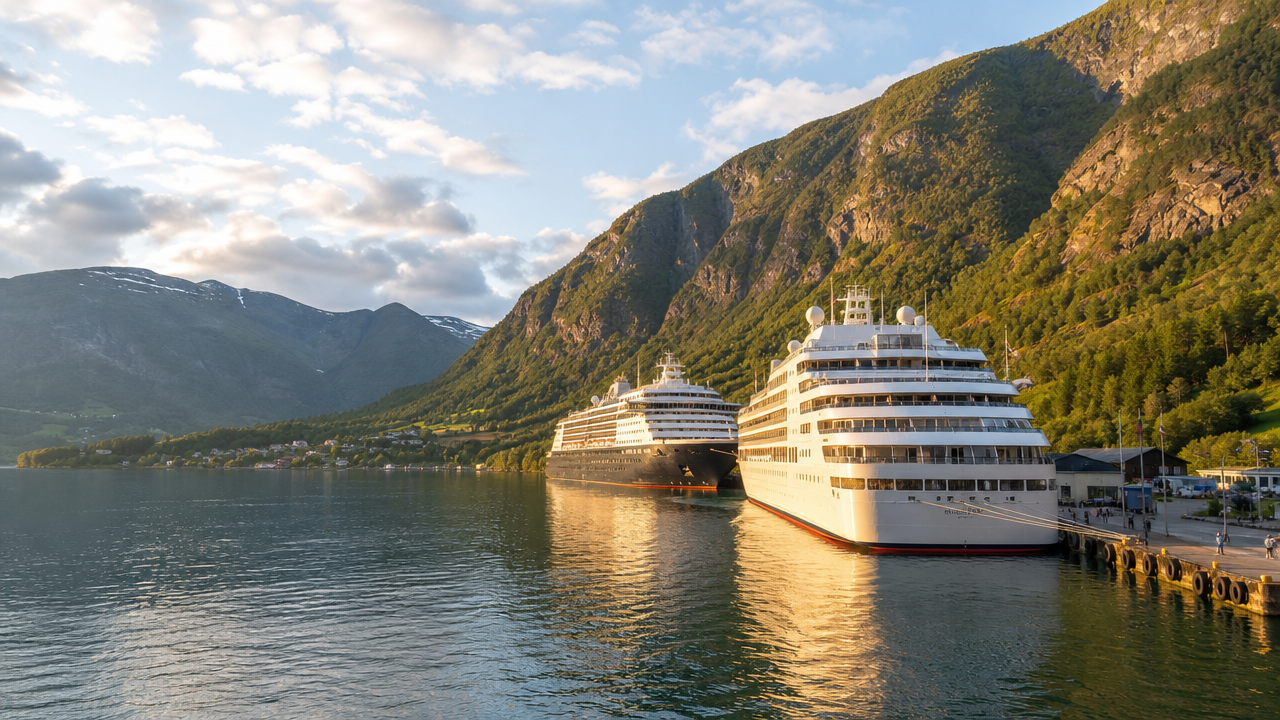
Flåm has roughly 350 permanent residents. On a busy summer day, the ships anchored and berthed in the Aurlandsfjord can carry more than ten times that number, and nearly all of those passengers step ashore within the same three-hour band. That imbalance explains almost everything about how flam cruise port excursions behave in practice. Nothing here is far away — the railway platform, the fjord cruise pontoons, the bicycle hire and the village centre all sit within a few hundred metres of the quay — yet capacity, not distance, is what decides whether a plan works.
The geography is worth understanding before the schedules are. Flåm lies at the head of the Aurlandsfjord, an arm of the Sognefjord, Norway's longest and deepest fjord system. The valley behind the village climbs steeply toward Myrdal, and it is that gradient the Flåmsbana railway was engineered to overcome when it opened in 1940, twenty tunnels and a gradient of 1:18 carrying passengers past the Kjosfossen waterfall. To the north, the Nærøyfjord — a UNESCO World Heritage site — narrows to roughly 250 metres between cliff walls, which is why the fjord cruise toward Gudvangen remains the second fixed point of most itineraries. Beyond those two, the options widen: RIB boats, kayaks, the Stegastein viewpoint above Aurland, guided valley walks, and the brewery and railway museum for anyone staying close to the pier. Norwegian signage will call these fjordcruise and utflukter, and the local phrasing is worth recognising on timetables.
What this means for planning is straightforward. Ships' own shore excursions guarantee the vessel waits; independently arranged trips do not, so the margin between a returning fjord cruise and the all-aboard time matters more than the headline duration. Railway departures are timed loosely around ship arrivals, but seats on the most convenient services fill first, and a passenger who disembarks at midday is choosing from what remains rather than what was advertised. The port area is open around the clock and costs nothing to enter, though that generosity ends at the operators' own counters. Anyone comparing flam cruise port excursions should therefore start from their ship's all-aboard time and work backwards, allowing a buffer of at least an hour on any trip that leaves the village by water or rail.
The reward for that arithmetic is a day that does not feel compressed. Flåm shore excursions divide roughly into those that leave the valley and those that do not, and the second category is consistently underrated — the Flåmsdalen valley path toward Brekkefossen, the shoreline walk toward Fretheim, the small church at Otternes further along the fjord. These require no booking window and no return anxiety. Passengers with a short call, or those disembarking from a tender in poor weather, often find the Flåm fjord tour they had planned is already full, and the village itself absorbs the afternoon perfectly well. Flåm landmarks are close enough together that a walking day is a legitimate choice rather than a consolation. The single decision that shapes everything else is when to leave the ship: early passengers set their own itinerary, late ones inherit whatever the morning left behind.